No Free Beach: The loss of a Lagosian Birthright
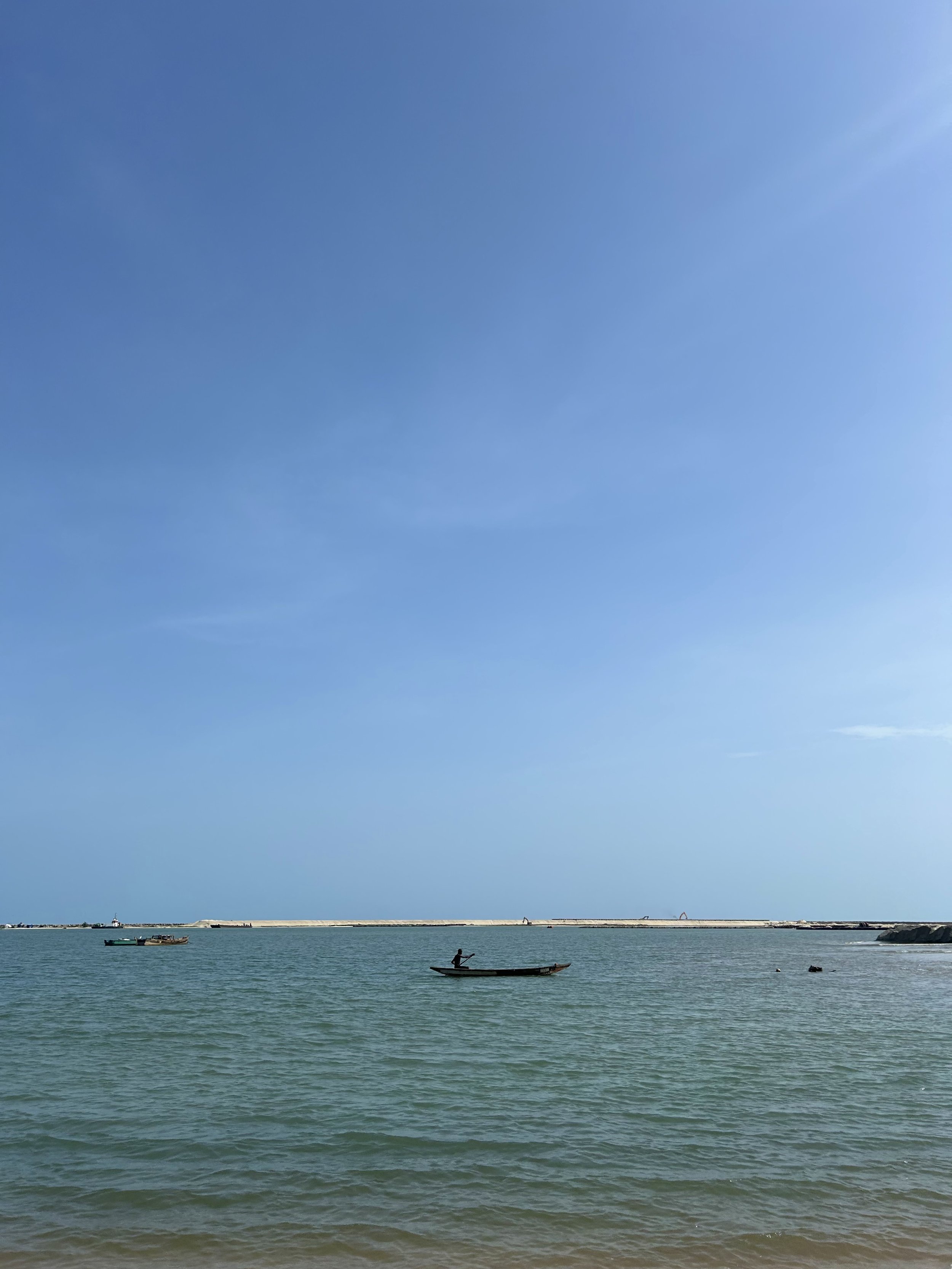
Source: Aisha Ayan, Lagos, 2024
My mother always prides herself on being Lagosian. She grew up in the 1960s, in Balogun, back when it was still a residential area rather than the bustling and rowdy marketplace it has become today. Her memories of Lagos are filled with stories of community, freedom, and safety. The closest beach to her home was Bar Beach, just a walking distance away. She recalls it as a vibrant place. Still, she insists that Badagry Beach was much more beautiful, lined with coconut trees that reminded her of the Caribbean.
For my mother, the beach was never a novelty. “Ko jo mi lo ju,” she says; it never dazzled her. I’m not surprised. She is a true islander; water and sand were simply part of her everyday world. But fast forward almost fifty years, and that humble and simple access to beaches has all but disappeared from Lagosian life.
The Shores: A Brief History of Lagos’s Coastline
Lagos is a coastal city in southwestern Nigeria, made up of islands, lagoons, and creeks, bordered by the Atlantic Ocean. Its geography naturally lends itself to beaches, with long coastlines stretching along the Atlantic. By the 16th–18th centuries, Lagos became deeply involved in the transatlantic slave trade, serving as a major slave port controlled by local rulers and European merchants till the 19th century. Later, during the colonial era, Lagos became a crucial administrative and commercial hub under British rule. After independence, Lagos remained the capital of Nigeria until 1991, when the capital city was relocated to Abuja. Lagos, however, remains Nigeria’s largest city and commercial centre.
Island Life, City Life, and the Price of Poverty
Today, alongside its eroding coastline, Lagos has lost almost all of its free beaches to privatisation and government fees for public beaches. Access to beaches may cost anywhere from 2000 – 3,000,000 naira. At the lower end of the price scale are typically public beaches such as Elegushi Beach. Which currently starts at 2k per adult; however, to access other facilities within the beach, beachgoers are presented with additional fees in order to supplement their stay.
For those who are amongst the higher earners commanding a more affluent place in Lagos society, a private beach is where they can be found on any given beach day. These spots, such as illashe beach houses, are available for rent for about 3 million naira and upwards. They are secluded from the bustle of Lagos life, well, that’s if you don’t consider the locals peering over the beach house walls through an act of innocent voyeurism, observing a reality extremely far removed from their economic realities.
So, Lagos beaches are no longer free and accessible, so what? Perhaps on the surface it’s not such a big deal - beaches after all are widely considered leisure spots. But the consequences of this shouldn’t be taken at face value.
“Bar Beach was considered a beloved and rare outdoor public space, one where Nigerians of all social strata would visit with their family. It was also a space of possibility — for dangerous but potentially liberating political or personal transformation” - Ben Mendelsohn
The growing shortage of access to nature, especially for islanders, is concerning because it signals the trajectory of the city’s future. It reveals a Lagos where inequality is not just economic and financial but also spatial. The erosion of free, communal access to beaches shows that the quality of life and experience of ordinary people in Lagos is being deprioritised. Beaches that once featured community and freedom are now being replaced with privatised, commercialised zones where access depends on purchasing power. Much like the real estate facade of “luxury”, the privatisation of beaches, as well as the implementation of fees, has severely reduced access to free beaches. Quite simply, this shows us that Lagos is being reorganised and redrawn through class lines and income.
According to Amnesty International, two-thirds of Lagos residents live below the poverty line of just US$1 a day, and over 70% of the population reside in informal settlements. For those who fall outside of this category, the situation is hardly secure. As Forbes Africa reports, the median monthly salary for men is only ₦70,000 (approximately $43.75), while women earn even less at a median of ₦50,000 (around $31.25). These figures highlight the economic precarity of Lagosians and the sheer amount of poverty within the city. Therefore, those living below the poverty line will have no disposable income to visit beaches due to the fees. Although for the average earner, beaches may not be off limits, but may be reserved for special occasions.
A common rebuttal to criticisms of beach fees is that charging for entry helps maintain cleanliness and keeps miscreants at bay. Yet, this argument falls short on several fronts. In reality, many public beaches are far from clean despite the fees, and there is very little to no transparency from the government about how this revenue is managed or reinvested into the beach.
More importantly, beaches are not a luxury; they are part of island life. To monetise them is to enforce a form of spatial exclusion, particularly for residents already struggling on or below the poverty line. Cleaner, safer beaches should not be achieved through exclusionary pricing but through collective responsibility. This is a task for both government and community-led initiatives. Public sanitation is a public good, and the cost of maintaining accessible beaches ought to be funded through proper allocation of government resources and tax revenue, not additionally shifted onto the shoulders of Lagosians. What, then, is the Lagos State government doing with all its tax income? After all, in most other African coastal cities, such as Accra, Banjul, Dakar, and Lomé, the public enjoys free access to the beach as a natural right, not a privilege.
Jamaica
Unfortunately, Lagos is not a trendsetter globally. Ninety-nine percent of Jamaica’s beaches are off-limits to the public, with less than one percent of the island’s coastline remaining freely accessible. What were once communal spaces have been licensed to private landowners and developers that offer “exclusive” beach access to paying guests.
This restriction of the coast is rooted in the Beach Control Act of 1956, a colonial-era law that grants beachfront property owners full rights to access and use the beach, while denying the Jamaican public any inherent right to bathe, walk, or fish along the shoreline. Though the Act was introduced under British rule, it remains in force today, shaping postcolonial Jamaican life and spatial inequalities.
Back then, access to beaches was inseparable from race and power, as colonial elites controlled the coastal land. In the postcolonial era, however, the basis of exclusion has moved. Beach access is now mediated less by race primarily and more by capital and class inequality, yet these inequalities remain racialised in practice. The luxury resorts and private developments that dominate Jamaica’s coastline are often from foreign investors and developers that primarily serve an international, largely white clientele, which reveals that these spaces of leisure and nature are reserved for outsiders and the wealthy, while locals are priced out of their own paradise.
Spatial Segregation and the Architecture of Inequality
As Jean Baudrillard observes, “The ascendancy of the urban and industrial milieu is producing new examples of shortage: shortages of space and time, fresh air, greenery, water, silence. Certain goods, which were once free and abundantly available, are becoming luxuries accessible only to the privileged.” This is precisely what we see unfolding in Lagos. Whereby natural elements of everyday life that were once free and accessible are being reclassified as luxuries.
It is not that Lagos actually lacks beaches, although the coastline is indeed eroding, with over 80% percent having been lost. Rather, access has been deliberately remodelled. The Lagos State Government’s complete destruction and sand filling of Bar Beach to create space for Eko Atlantic is emblematic of this issue. Eko Atlantic itself stands as a monument to hierarchy and inequality – both economically and spatially. It is a 6-billion-dollar artificial city for the wealthy, built on what was once a free communal space for ordinary Lagosians. So, beaches are not scarce, but the ability of the public to enjoy them freely has been systematically curtailed.
Sociologists view inequality as a relational problem. It is not only measured through disparities such as income but also understood through the social dynamics between people, the spaces they inhabit and urban design. In societies marked by inequality, the wealthy often seek to enclose and insulate themselves, a phenomenon Davis (1990) describes as “architectural policing”. In Lagos, the proliferation of private beach houses is a clear example of such class clustering, producing what Ash Amin (2012) calls a “cauterised society”, where the socio-economic lives of the over-privileged are sealed off from those of the ordinary and precarious, even when ironically, in Lagos, poverty and precarity exist right at the tip of their nose.
As Tonkiss reminds us, “Inequalities are produced and expressed through social and spatial modes of distinction, separation and exclusion, from broad lines of urban segregation to legal and cultural demarcations around gender or race, and in the smaller logics of spatial ranking which see some go to the head of the queue while others go to the back of the bus.” This framing helps us understand Lagos, a city where inequality is not at all abstract or codified in economics, but materially embedded in its geography, and where access to space, whether beaches, housing, schools or infrastructure, is contingent on privilege.
Final thoughts
My mother, growing up, was never fazed by the beach. Understandably, she took it for granted. But things are no longer the way they once were.
Water is a joy; it is tranquil, restorative, serene and for some, spiritual. The beach is arguably one of nature’s most remarkable gifts; it is a self-sustaining ecosystem that has always thrived without human intervention. Yet today, in a hot tropical city, there is little respite. These natural spaces are increasingly monetised and exclusionary. This is due to the parasitic nature of urban development in the city, characterised by severe levels of inequality. It reveals a worrying decline in the quality of life for ordinary residents and an institutionalised denial of an islander’s birthright.
Yes, Lagosians are losing their beaches, although not to the sea, but to the relentless tide of capitalism.